What AI missed when planning an auth migration across ten applications
Introduction
I recently upgraded the auth for a SaaS platform running on a custom auth solution with roughly 10 distinct client apps. The existing system had been hardened well and got through many penetration tests over the years but any new changes to it required careful custom auth coding. No one wants to do that!
It took a few months to add new auth alongside the existing legacy auth system. AI helped with the implementation for sure, but it needed significant hand-holding and many small targetted PRs to approach a solution that I was happy with.
When I finished the work I thought this project would make a great eval at a "staff engineer" type level of planning. Personally, I would just give this work to a trusted staff engineer as "OK, it's time to upgrade our auth to support modern negotiation etc. Go figure it out".
I built the eval to test how state of the art agents might approach this problem, and the results matched my experience doing the work where they just weren't great.
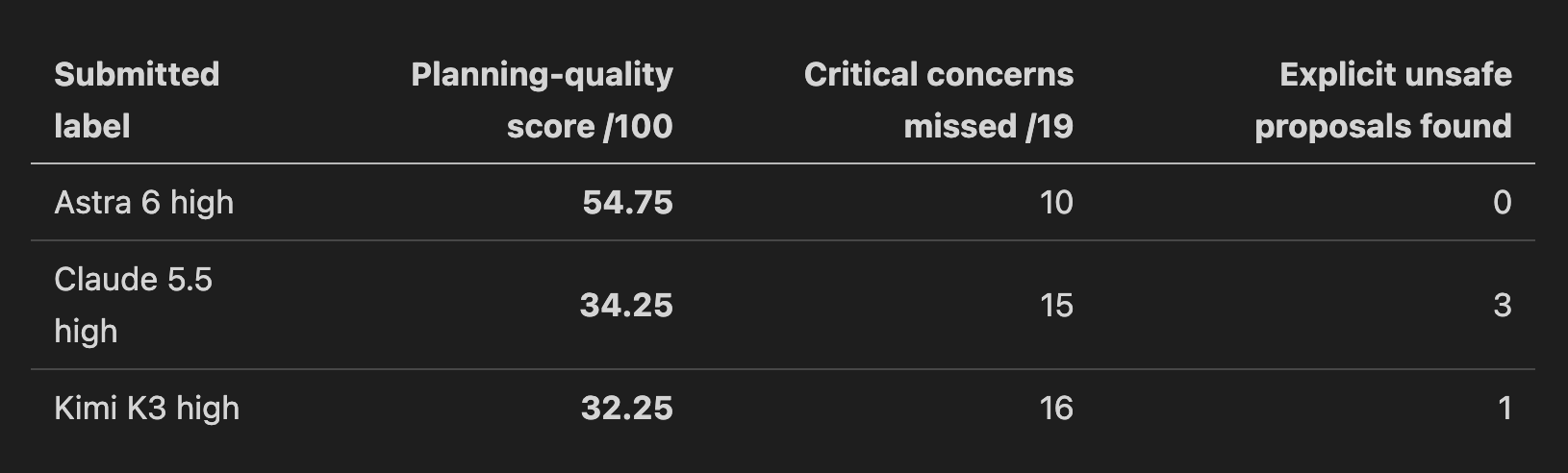
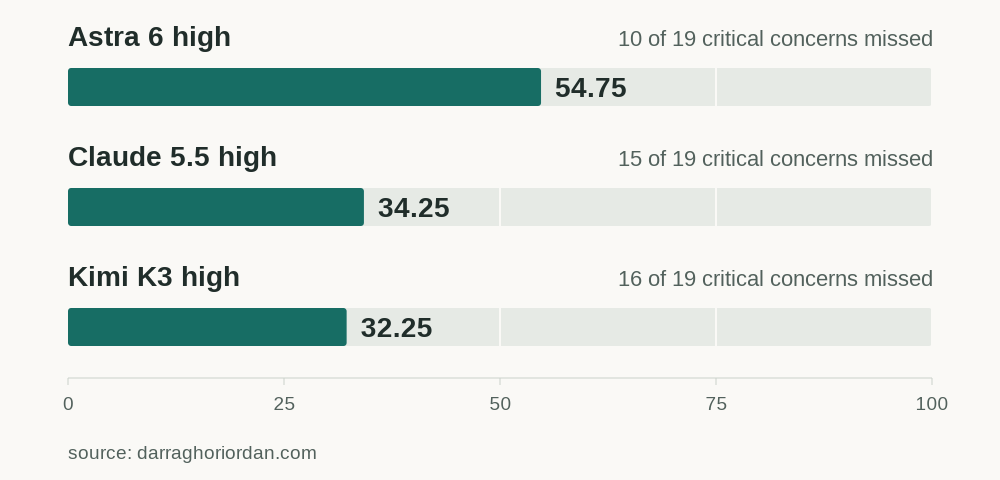
- The strongest submitted plan scored 54.75/100 and missed 10 of 19 critical concerns.
- All three plans missed an existing authenticated connection outside the ordinary HTTP request flow.
- Some proposals introduced unsafe identity matching or rollback assumptions.
Why was the change complex?
- Ten existing applications were affected. They had various existing semi-hand-rolled token negotiation mechanisms - cookies, redis sessions, negotiated JWTs, long lived tokens.
- Existing customers needed continuity of access. There is a full organisation model in the platform so there would be partial org-users updated to new auth.
- Permissions and account ownership had to remain correct. There are a few different mechanisms for this
- Old and new authentication needed to coexist during rollout.
- Recovery, revocation across single user and all org users mattered. If new auth had bugs we had to be able to restore a users old login flows.
- There was some impersonation used that had to be replicated.
- There were unsupported hashing algos used in existing in places.
- There were deployed applications that are difficult to update (Mobile clients)
The plan needed to consider
| Area | Example concern |
|---|---|
| Identity and access continuity | Customers retain their accounts, permissions and usable login methods |
| Integration discovery | Every credential consumer is identified, including less obvious connections like long lived tokens or websockets |
| Authentication and authorization | A valid identity still needs current permission to perform an operation, i.e. do they have an active subscription |
| Migration and recovery | Partial migration failures and changed credentials have a safe recovery path |
| Operational readiness | Configuration, deployment, background work and interfaces remain coherent |
| Planning discipline | Dependencies, validation, tradeoffs and unknowns are explicit |
Building a benchmark
- Snapshot the codebase before the auth migration.
- Use the actual implementation code to list the required outcomes. This actual implementation is the best way to identify a good outcome.
- Give models the starting code and a fixed product brief.
- Assess their plan outputs against the outcome-based rubric.
The scoring rubric ended up having 18 categories, 72 checks, 100 weighted points, with 19 critical checks identified and reported separately.
Samples of some of the tests are
- **R03.c** (critical): Preserve existing authenticator secrets and require completed MFA before treating a password flow as fully authenticated or upgrading its credentials.

- **R05.c**: Include report-builder/PDF or preview-report credential exchanges and URL/media attachment consumers that are outside ordinary JSON API requests.

- **R05.d**: Include WebSocket connection/reconnection credentials and route the actual callers through a coherent credential-selection strategy, with a bounded reconnect/expiry plan.

- **R10.b** (critical): Support resumable pending onboarding and synchronize verification to the correct activation attempt; unfinished onboarding or email verification must not bypass MFA or grant full application access.
Eval Results Oct 2026
The best performing model, OpanAI's Astra, scored 55% on the eval although it missed about half the critical marked requirements.
The other two models I tested clustered around 33%. It is surprising that the Kimi K3 model scored so similarly to Claude Opus 5.5 to be honest.
Example 1: Assuming that a rollback would have consistent data
Consider the scenario where
| Event | Consequence |
|---|---|
| A customer migrates with password A | Both systems initially recognise the existing credential |
| They change to password B in the new system | The old system may still recognise A |
| An operator flips authentication back | The current password may fail, or the superseded password may work |
This was consistently missed in planning for the authentication migration. Maybe it would have been caught during implementation through detailed e2e tests but I'm not sure. These kinds of latent, disparate, cause and effects in software still cause issues for models in other work I do too.
Example 2: A matching email address does not establish account ownership
Assuming that an email address provided by the IdP or authority can be resonable if you follow their recommendations. e.g. google claims if an email is verified and if it is the authority for it. So you might assume the authenticaton success assumes ownership.
AppleId adds masked email addresses for privacy so there is no way to assume legacy account email ownership for connections. It must be manually done. This requires new UI, OAuth continuations and potentially MFA verification.
This kind of complexity requires careful context consumption by both humans and agents. i.e. RTFM. Again, this might have been found out with an un-sandboxed eval agent environment but instead the agents made assumptions here. I would expect a staff engineer to say, "I need to read those docs before committing to a solution here".
There were many more of these kinds of failures in toughtful planning and investigation with the models.
Planning with AI in 2026
I think that minor changes like update the button etc can just be one-shotted. Without a doubt this kind of software eng is dead. There is 0 value for business in having paid humans do this kind of work any more.
I think you absolutely still need experienced engineers to plan and execute complex changes around platforms. How long this will last I don't know but I'm not convinced it will be 1in 6 months or other crazy claims like that.
This is still a miraculous technology to get 50% in an eval this complex. Just astounding how things have changed in one year.
Limitations of this Eval
- I sandboxed the agents. Code snapshot inspection only. Authentication is largely a solved problem so I didn't think there would be a huge benefit from internet access. One submission did disclose web access despite the no-network protocol - Claude 5.5 High - but it didn't seem to help it.
- I used opencode as the harness for all models. This probably put claude at a disadvantage because the Claude Code harness is supposed to be excellent. However the same issue should apply to OpenAI and codex/ChatGPT (I use this primarily).
- I implemented the solution based off my experience with auth over the last 20 years and I didn't plan out the change in huge detail before starting. So is it fair to ask a model to do it? I think so as a way to counter the claims that they are this capable.
- I used Astra High to evaluate the plans from all the other models. This shouldn't matter because it is measuring against the existing rubric only. The rubric used was the same for all plans but maybe there is something I'm not thinking of there.